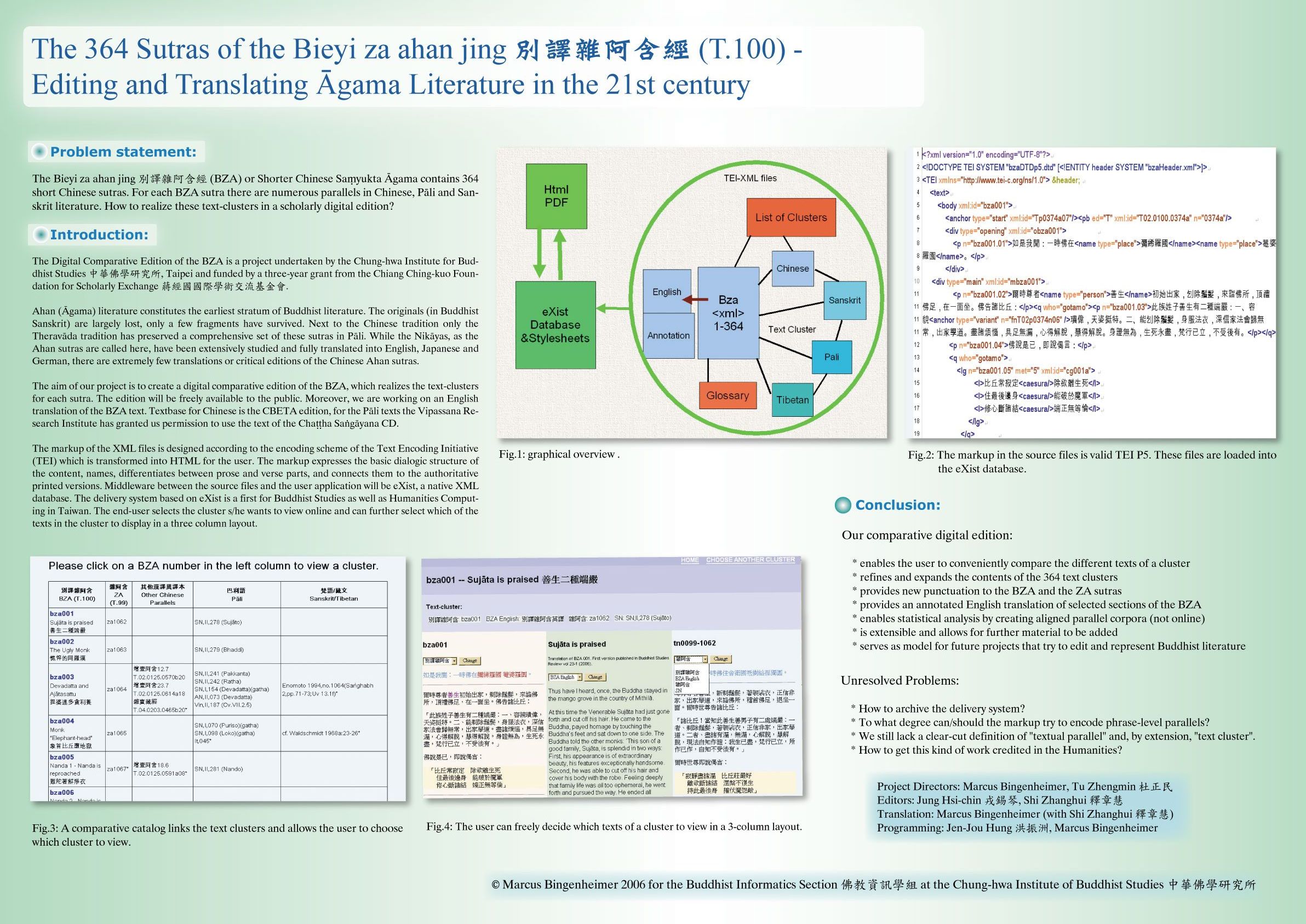
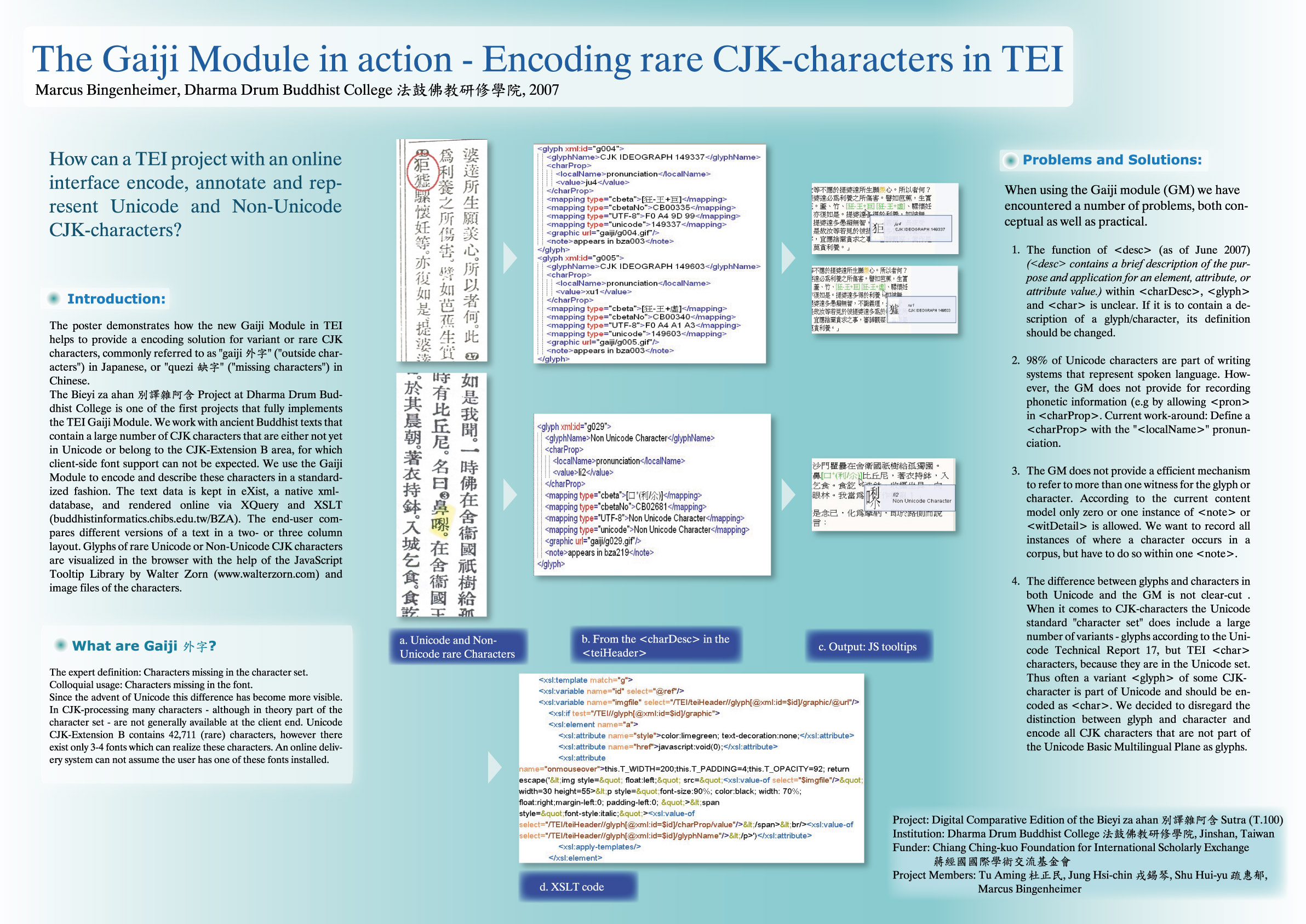

The Digital Comparative Edition of the Bieyi za ahan jing 別譯雜阿含經 (BZA) is a project undertaken by the Dharma Drum Buddhist College 法鼓佛教研修學院 and funded by the Chiang Ching-kuo Foundation for International Scholarly Exchange 蔣經國國際學術交流基金會.
This comparative digital edition:
The Bieyi za ahan jing 別譯雜阿含經 (BZA) consists of 364 sutras and belongs to the early Chinese Buddhist texts collectively called Ahan (Āgama) sutras 阿含經. Ahan literature constitutes the earliest stratum of Buddhist literature. The originals (in Buddhist Sanskrit) are largely lost, only a few fragments have survived. Next to the Chinese tradition only the Theravāda tradition has preserved a comprehensive set of these sutras in Pāli. While the Nikāyas, as the Ahan sutras are called the Theravāda tradition, have been extensively studied and fully translated into English, Japanese and German, there are extremely few translations or critical editions of the Chinese Ahan sutras.
Generally, all of the 364 short sutras contained the BZA have at least one parallel in Chinese and one Pāli parallel (with commentary). Often there are several parallels in Chinese and Pāli, at times even a fragment in Buddhist Sanskrit[1] has survived. This project has created a digital comparative edition of the BZA, which connects these text-clusters. The source files of the edition are freely available. Moreover, we have studied several aspects of the text and translated parts of the BZA into English with extensive annotation.[2] Textbase for the Chinese is the CBETA edition, for the Pāli data the Vipassana Research Institute has kindly granted us permission to use the text of the Chaṭṭha Saṅgāyana CD.
The markup of the XML files uses the encoding scheme of the Text Encoding Initiative (TEI) which is transformed into HTML for the user.[3] The markup expresses the basic dialogic structure of the content, names, differentiates between prose and verse parts, and connects them to the authoritative printed versions. For the Pāli and longer Chinese parallels the markup distinguishes between larger parallel and non-parallel passages.
Each of the 364 BZA sutras is presented within a cluster of its parallels. All texts within a cluster are linked through a comparative catalog. Middleware between the source files and the user application is eXist, a native XML database. The end-user selects the cluster s/he wants to view online and can further select which of the texts in the cluster to display, in a two- or three column layout. The project was started in summer 2005 and concluded in autumn 2008.
The database output is best viewed with Firefox, Mozilla or Opera though basic functionality is provided for inferior browsers as well. There is a bug in IE 6 that scrambles some unicode characters (this seems fixed in IE 7).
Project Directors: Marcus Bingenheimer, Aming Tu 杜正民
Editors: Jung Hsi-chin 戎錫琴, Shi Zhanghui 釋章慧, Chueh Huichen 闕慧貞
Editorial Assistant: Shu Hui-yu 疏惠郁, Wang Ruixiang 王瑞鄉, Zheng Baolian 鄭寶蓮
Punctuation of BZA and ZA: Shi Zhanghui 釋章慧
Translation: Marcus Bingenheimer
Search Interface: Simon Wiles
Programming: Jen-Jou Hung 洪振洲, Marcus Bingenheimer
[1] Much of the Prakrit and Sanskrit material included in this edition has been made available by Prof. Fumio Enomoto (Osaka). We thank Prof. Enomoto for his generosity.
[2] Marcus Bingenheimer. 2011. Studies in Āgama Literature - With special reference to the Shorter Chinese Saṃyukta-āgama. Taipei: Xinwenfeng 新文豐. Some of the material was first published in the Buddhist Studies Review.
We thank BSR and Equinox publishing for allowing us to reuse the material in our database.
[3] Posters on the technical aspects of this project have been presented at several conferences see here for a poster on the project design and here on a poster concerning the gaiji-module, i.e. our solution to the representation of rare characters.
中文
Choose a Cluster
Search
BZA Sutras in Original Order
BZA Topics
Abbreviations
Bibliography
Notes on Gaiji Pronunciation
Download Archive
